Monday, August 16, 2010

Helicopter Tree Trimmer (Video)

I know its been a while since I have posted, but after arriving in California I didn't really have access to the internet, and since I've come back I have been very busy flying with my students. Kevin got his medical certificate while I was gone, so on Saturday, I endorsed him for solo flight. The next day, I let him go on a cross-country flight. He trained to the solo stage about 10 years ago, and has several hundred hours as a passenger in light planes. Really, he should have his license - at least, that is his skill level, so we are working on getting the legal boxes checked.


On Sunday, as Kevin was leaving for his flight to Moorehead, KY, a helicopter came in to land with an external load. The company trims trees by power lines, and uses this huge aerial saw.


I got a video of it landing. The boom that connects the saw to the chopper is a rigid pole. Quite impressive to see them sit it down.


More to come in the next few days, I'm still getting things together after the trip, and trying to get moved out of our old apartment, so posts may be about once a week (give or take) for a while.

Saturday, August 7, 2010

Driving Cross Country

Well, I usually post about my flight, especially cross-country trips. I'm not traveling via air, but I have been on one hell of a cross-country trip. I'm driving with Megan from Ohio to Los Angeles. We left home about 48 hours ago, and are now lounging in Seligman, AZ. L.A. is only about 400 miles away (total trip length is about 2250). One thing I noticed is that the terrain didn't change much until we got to New Mexico. Even Oklahoma and the parts of Texas we drove through looked a lot like northen Kentucky - at least from the ground. I'm sure the differences would have been a lot more obvious from the air.

Here are some pictures from along the way. I'll caption the ones I can remember anything about. I took a picture every hundred miles, exactly on the mile, regardless of what was outside the window. Some of them are good, some of them...


The St. Louis Arch - Gateway to the West. Saw this our first day out.


Wind Turbines in Missouri. Saw a lot of these is every state west of Illinois


After we made it to New Mexico, we saw a lot of very dramatic scenery on the horizon, but the Interstate only took us close a couple times. This is west of Albequerque.


We also saw a lot of trains, sometimes several at a time. We could usually see the entire train at once because they were far from the highway and the land is so flat and devoid of buildings or enough shrubbery to block the view.


And in the interest of keeping it Aviation-related, I snapped this picture of the Winslow VOR through the heavy rain we encountered in Arizona.

Saturday, July 31, 2010

When The Twin Breaks Down...Send A Skyhawk To The Rescue!

The weather was not looking too great - low clouds, rain showers, and grey skies were the first things I saw when I woke up. After checking the weather a little more closely, I called and cancelled my only student for the day. Our planned flight time of 3pm would put us squarely in low visual conditions and scattered thunderstorms. In anticipation of a relaxing day off, I ran over to the airport to pick up my paycheck.

When I walked in the door about 11:30am, the chief mechanic called me over as he was hanging up the phone. "Hey, one of the other pilots is out in the (Cessna) 414 and when he tried to start the left engine, it had some oil pressure problems. He is stuck in London, KY. Want to go pick him up?" In pilot-speak, he had pretty much just said "Hey, take an airplane and have fun all day doing what you want, the company will pay for it." Of course I accepted.

The first thing I did was to go over the weather in a lot more detail. Most of the crap was pretty far south and moving due east. Nothing was going to build too soon, and cloud bases were reasonably high above the ground for the entire route with good visibility underneath. I decided that as long as I didn't waste time, I could get down there and pick the other pilot up without worrying about the weather too much. He had the Garmin 396 handheld GPS with him, so we could use it's XM weather feature for strategic storm avoidance on the way home. I immediately started to preflight an airplane and file a flight plan. The plane I decided to take has a cruise prop on it, so it goes a hair faster and uses less gas than the others. It also has a Garmin GNS430 in the radio panel - an IFR-certified GPS. This tool makes IFR work a lot easier. As I was doing the pre-flight, my first private pilot student, Francis, came to the airport. He had just stopped by to drop off a check, but after I told him what I was doing he asked if he could go. I told him to check the weight and balance, and he could go if it was OK. It was OK, but just barely, and he decided to stay on the ground.

Only after I fueled up and started the engine did I remember that this plane has been having problems with the navigation radios - it wasn't legal to fly IFR. I ended up having to call Flight Service back and cancel the first flight plan and file another one, with a more complex routing. Then I had to put the first airplane away and do the entire preflight-fuel-setup the cockpit-game on a second plane. I finally got my clearance and off the ground, but I was about 35 minutes behind schedule.


This is a picture shortly after takeoff. You can see the wings are level, airspeed good, positive rate of climb, and right on course. You can also notice that the only thing to see out the window but a big grey nothing.


This picture is looking out the rear side window during the climb. You can see three states, Ohio north of the Ohio River (the bigger one), Kentucky to the left, and West Virginia to the right. KY and WV are separated by the Big Sandy River, which is smaller than the Ohio River.

At my cruising altitude of 6,000 feet, I was between layers of cloud and had about 15 or 20 miles of in-flight visibility. I could see scattered columns of cloud rising out of the floor below me and into the ceiling above, it was a very cool, and somewhat spooky, sight. I flew about 80 miles when I saw my in-between area of clear end, about 20 miles ahead. I was about 15 miles from London. I continued to get closer to London, but the wall of weather stayed where it was. The Air Route Traffic Control Center (ARTCC, or center from now on) advised that they were showing an area of heavy to extreme precipitation ahead of my position, about 5 miles west of my destination. This was the crap I had seen on radar before takeoff and wanted to avoid. I would have made it with time to spare had the first plane been servicable. Not having on-board weather of any sort, I decided to take Indianapolis Center's advice and go back the way I had come. Being IFR with embedded storms and extreme precip is not where I want to take myself.

I set course for the Hazard, KY airport, about 30 miles east of my destination, London. When I got in the area I noticed the weather was a bit worse than it had been as I passed through earlier. The space between layers was still there, but the undercast was now solid rather than broken and a light rain was falling from above. From directly over the airport I turned west, outbound on the VOR approach, and began to lose altitude. Several miles later, when I turned inbound and crossed the final approach fix, I started trying to spot the airport. As the distance measuring equipment (DME) counted down the remaining miles to the airport, I began to think I might miss the approach - there was a large cloud ahead of me. I entered the cloud about 1 mile from the missed approach point. Just as I reached the MAP, I broke out of the other side of the cloud, spotted the airport, and landed at Hazard.
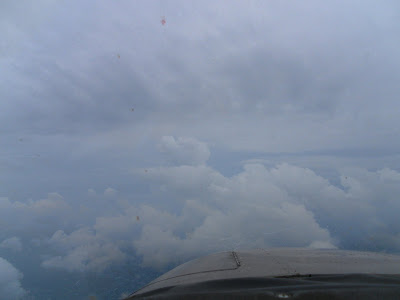

Here is another picture of some unnamed and unknown locale along the way. Notice the upper and lower cloud layers I mentioned earlier. When IFR, real-world locations don't really mean anything. The only reason you know you are moving is because the needles and numbers of the navigation equipment move. That and, well, airplanes can't exactly stop in mid-air.

After shutting down, and a quick dash through the rain, I found myself in a mostly-deserted and very typical small-airport FBO. My cell was dead, which made things difficult, but I got it to turn on long enough to get some phone numbers out of it. I called back home and let Megan know I was on the ground. Then I called home base to make sure I still needed to complete the trip - the pilot who was stranded with the 414 is also an A&P (airframe and powerplant mechanic). I was told that he was working on it, but still stranded, and the problem looked fairly serious, so I could continue if able. A quick glance at the radar confirmed that I was unable to continue for now. Every place between Hazard and home was clear of storms, but just north of London, there were scattered storms coming one after the other. I decided to take a crew car, drive into town, and get a bite to eat.

Town turned out to be a bit more than the advertised 10 minutes away from the airport. As I drove, I started to wonder if this sort of stuck-in-BFE-all-day-by-myself is fairly common for pilots. I suppose it is, which is OK, but sometimes I'd rather be home - especially when its supposed to be my day off. The valleys the road is built in were full of cloud and mist, and a light drizzle really made the entire day seem melancholy - especially because of the dilapidated-dirty-poor-coal-mining-area scenery. Not a cheerful place to live, thats for sure. After a quick bite to eat, I headed back to the airport. I was only gone for an hour. When I got back, I looked at the radar, decided it was time to go south, and called back home just one more time to be sure I should go. As it turned out, they had gotten the 414 repaired just before I called, and had departed London headed home just 10 minutes earlier. Aw hell.

I called Flight Service, filed the 12th flight plan that day, jumped in the plane, picked up my clearance, and headed for home. By this time, the weather south was flyable and the weather along my return route north was getting much better. The day's heat, which drives such storm patterns, was waning - it was almost 6pm!


Here is some cloud on the way home. Notice the layer dead ahead and same altitude - I punched right through that, but for the first time all day you can also see blue sky.

Local Approach was really friendly, as always, and offered me a localizer approach to get in. I accepted, and as I was starting to get radar vectors, they told me the ceiling was high enough that I could probably just get in by descending to the minimum IFR altitude and getting under the cloud deck, which was rising anyway. I told them that would be fine, and it would save about 15 minutes. The plan worked well, and I arrived home just as the last of the rain was clearing out. After cancelling my IFR clearance, I tuned to the UNICOM frequency for the home field and was surprised to hear someone answer me from the office. She had waited around for me to get back, and I was truly grateful. It was a fun day, but long, and I really got to exercise my decision-making and IFR flying abilities.


I took this picture right after I arrived. You can see the edge of the cloud layer - the last little bits of scud - moving away from the airport.

In retrospect, I did many things well, and a few things not so well. My first mistake was in getting delayed by about an hour. I missed my window for an approach to London by about 5 minutes. The second mistake was circling to land at Hazard. I should have started to slow the plane a bit earlier and landed more normally. Or I should have just headed for home. Neither one a big mistake, but things to think about next time I'm up in the soup. I made a lot of decisions that I was proud of, however. The decision I liked best was the decision to divert once I knew the flight could not be completed, and not before. I diverted to a relatively close location with known facilities and known flyable weather, rather than just turning tail and going home.

It was a fun, challenging day, and I got time in actual (which is very valuable experience-wise). My biggest complaint is that Francis didn't go with me, since I never did actually pick anyone up.

Sunday, July 25, 2010

A Matter Of Perspective...

In a typical day at work, I have between 3 and 5 flights. Of these, over 90% are with primary flight students. Some of the clients have been assigned to me, for others I am just pinch-hitting for their regular CFI. There are so many of them, but only one of me. Lately, I've been thinking about the way I experience a typical day at the airport vs. the way a flight student is likely to experience the airport. I am not much of a writer in the artistic sense, but I'm going to try a journal-like style for this post. I hope it works.

For the record, all of the people, events, and opinions described herein are entirely fictional. This is just a literary experiment. I hope it doesn't sound too pessimistic.

Tuesday, 7:22am
I glide my car into the usual spot in the shade by the FBO building. Just finished eating a peach and drinking a cup of coffee. I grab the flight bag, stack of papers, phone, sunglasses, and water bottle that make up my usual equipment for a long day. The morning fog is mostly gone, which is good. I have a student, a doctor learning to fly before clinicals each day, scheduled eight minutes from now, and I need to unlock the building, gas pumps, and get a flight briefing for the day before he arrives. We are both on a tight schedule this morning.

Tuesday, 8:07am
The doctor is here, and we just arrived in the practice area at 3,500'. He has had about 4 flight lessons so far, and today we are starting power-on stalls and recovery from them. After a steep turn and some basic maneuvers as a warm-up, I coach him through the first power-on stall. "Bring carburetor heat on, then bring power to 1500 RPM and add back pressure to maintain altitude, just like the slow flight we did two days ago. When you get an airspeed around 55 knots, bring your power to 2000 RPM, hold the back pressure on the yolk, and let the nose pitch up. Then, continue to bring the stick back until the stall occurs, the nose gently falls to the horizon, where you will relax the back pressure and pitch for a 70 knot climb." Sounds basic, tame, even monotonous to me. I know how the plane will react and am comfortable with it. I am also confidant in my ability to recover from anything could do to us. When we try the first stall, however, I can't convince him to bring the nose up enough to stall the plane. "Keep adding back pressure" I say. Finally, I add a gentle tug to finish the maneuver. The good part was that his instinctual reaction was to relax pressure on the stick. The bad is that he was a bit overzealous, and we are now in an accelerating dive. After returning to straight and level flight, it occurs to me how intimidating, even scary, this could be for a new pilot. Who am I to coax him into making the plane fall on purpose, what foolishness is this? Whats more, he is probably wondering if this kid next to him who is young enough to be his son can save the plane if something goes wrong.

Tuesday, 11:43am
Just finished a short cross-country flight with a college student learning to fly this summer. During the de-brief, I am thinking about how nice the AC feels, and feeling a bit hungry. Just another flight, to that same airport, 54 nautical miles away. My client, however, is really excited, remembering all the sights along the way, and asking a ton of questions. Don't get me wrong, I love what I do - teaching and flying, but sometimes it is easy to forget how blasted lucky we professional pilots are to see the things we see and do the things we do. Sometimes, it takes a fresh perspective to make us remember that. Sometimes, this is what I think about after that student has gone home, and I'm on my way across the street to grab lunch.

Tuesday, 2:18pm
Many afternoons around the airport are hot and boring. A lot of people who can afford to learn to fly are at work. The rest often don't want to fly during the hottest, stickiest, bumpiest part of the day. This is usually when I wander down to the maintenance hangar to relax in the air conditioned office, chat with the airport regulars, or volunteer some work time in the shop (refurbishing spark plugs, putting oil in motors, reassembling basic parts, etc.). This is also the time when I sometimes wish I was flying any of the planes in sight other than the Cessna Skyhawks. After over 400 hours in the front seat of a particular plane type, anything else (bigger or smaller, faster or slower) looks like paradise. Then again, I'll bet the small business owner won't look at the trainer plane in quite the same light when he arrives at 4:00. He walks in and sees an actual airplane. It is a Cessna, the brand that everybody has heard of but probably never touched. It is one of those beautiful "little" planes that his co-workers and family see as either dangerous or pointless. To him, it is the most fun he has had in years, a challenge, a tool, and a path to the dream of learning to fly.

Tuesday, 5:37pm
The chief pilot just called and asked if I have time to sub for one of the other CFIs who can't fly with his regularly scheduled student. I have a break in the schedule, and was planning on heading home for a couple hours before my night cross-country trip this evening, but I can stay. I'm looking forward to meeting someone new, seeing if I can help them hammer out the landing flare, and maybe looking forward to the extra hour on my paycheck, just a little.

Tuesday, 8:58pm
Now I'm flying with a middle-aged professional. He is almost done with flight training, and we are finishing the last of his night-flying requirements. I've now been at the airport or in an airplane for thirteen and one-half hours. I have made about 7.5 billable hours. We are almost home from a short cross-country destination. I'm drilling him on flight by reference to instruments, night-time optical illusions, emergency procedures, navigational chores, and nagging about using that checklist again. In the back of my mind I'm thinking about getting home to my girl, how tired I am, and the disparity between the hours I work and the hours I get paid for. Again, I love my job, but we can all imagine something a little better, can't we? During takeoff on our way home, I noticed that the landing light burnt out, but I don't think the student did. Oh well, he will figure it out soon. I hope it doesn't cause him too much concern when he does, I was going to have him land with the light off anyway, the landing lights burn out so often on these old planes that landing lights out is just another maneuver, just a training exercise. Still, as we plow on over small towns along the interstate home, radio chatter at a minimum, the air still, the world seeming to slow down and almost stop; things are peaceful, and beautiful. Without a word spoken, I realize that we are both admiring the beauty of the earth at night as only aviators can. For the first time all day, I think we are seeing things the same way.

Wednesday, July 21, 2010

Beautiful Picture on a Foggy Evening

Snapped some pics as my student-who-would-have-soloed-if-he-would-finish-his-paperwork took us around the patch. This one really stood out. All the mist/fog came from the really high humidity from the torrential rain of the past 30 hours or so. Enjoy.

Wednesday, July 14, 2010

Quick Update (and another solo!)

I am still working on a post about my developing perspective on flying every day, but until I can complete that train of thought I'll share some pictures I took today.

First, here is Dustin, who flew solo today for the first time in his life!


We started the day by practiceing various takeoff and landing techniques. It has been several weeks since we have done nothing but landings, and I wanted to be sure he was in the zone. Last week we flew a cross-country trip together, and I wanted to brush up a few skills I had seen on that flight. The flight before that one, I had decided he was ready to solo, but then a two week break set us back a little. Today, however, he was at the top of his game. I didn't bother telling him that there was a variable crosswind to 8 knots - words that would make a lot of pilots nervous. He flew the pattern perfectly each and every time, and was compensating without even thinking about it, so why bring it up?

I wanted to surprise him with the solo, because I didn't want him to overthink things, so when we taxied in to get some gas, I nonchalantly asked if he had gotten his medical yet, and if I could have it to make a copy for our files. One of the other CFIs asked if it was going to be a solo, and I said "no" so as not to ruin the surprise - we had just come in to get gas and use the head.

After getting back in the plane, and one final circuit around the pattern, I asked Dustin for his medical while we were taxing back to takeoff. He gave it to me, I signed it and his logbook, and then said "give me three normal landings" and jumped out.

He made three beautiful patterns, and the touchdowns were the best of the day. I really felt better about soloing my second student, and was a lot less nervous this time as I watched him climb away from the runway. I didn't have him fly with one of the other CFIs, this was entirely my own judgement call, and I knew it was the correct decision, even with the wind. Now, all we need is some better weather. Shortly after Dustin went home (to celebrate, I presume), the day turned into this and we aren't expecting anything better for about 48 hours.


Notice the red and white plane, N1868V, which comes into view tied-down near the the grass when the camera pans left. It is a new plane for the flight school, a 1975 Skyhawk. She flys true, climbs well, and is quite fast with the wheel pants on.

Wednesday, July 7, 2010

Flying a Cessna Original

Flew in an interesting plane today. Dubbed the "Rainmaker II" by its owner, N8574B is an original Cessna 172. As always, click the pictures for a larger, higher quality version. The older, 1970s models I teach in are, roughly, the 15th versions (L, N, and P models), and the ones produced today are S models. 74B isn't any model, its an original, manufactured in 1958, and it isn't what we would consider in "mint" condition, with a few stickers and a rattle-can paint job. The owner lives in Alaska, but his nephew lives here, and wants to finish his pilot training that he started about 7 years ago. Of course, he wants to fly the uncle's plane, which will be much cheaper (has to buy about 5 gallons of $4.50/gal gas per hour vs. a $90/hour rental).

There are many differences between the Skyhawks I usually fly and this early-model bird. First of all, the engine is a 6-cylinder, but rated at the same horsepower. Second, the plane is a lot lighter than the later models. Since the engine is flatter, the cowling (nose) is flatter, and so is the instrument panel. The windshield is bigger, and there is better visibility out the front, it is really cool. The tail is more square, which doesn't affect flight characteristics, but is very noticeable in this picture, which has a newer Skyhawk tail in the background for reference. Also, the plane sits much higher off the ground, so the sight picture is a little different and thus the landing also. Flaps in the school planes are electric, and when you select the flap lever, it takes several seconds for them to deploy or retract. In 74B, there is a big manual lever on the floor, much like the emergency brake handle in a car. Its really cool because you can go from zero to full flap much more quickly, and take them out quickly also. The final difference about the old plane is the way a vacuum is generated to power some of the gyroscopic instruments. In newer planes, there is an engine-driven vacuum pump to provide a vacuum source, but many older planes have these:
Each of these two tubes is called a venturi. As air passes through the narrower part, it speeds up, and as the speed of a fluid increases, the pressure decreases (this is Bernoulli's principle, one of the same effects that create lift in a wing). This vacuum is connected to the gyros. This is awesome. Cessna 172s are certified for spins, but normally can't be spun because there is no way to legally disconnect the gyros. If you spin the plane with the gyros powered, the bearings wear prematurely, which is especially bad for planes certified for instrument flight - where the 3 gyros are the only way of controlling the plane. Since this 'hawk has venturi-power (they aren't very good, especially at low speed) and is not certified for IFR, and the gyros are ancient, nobody cares if the plane is spun.

Spins have the reputation of being dangerous, but it would be more accurate to say that unintentional spins are dangerous, and spins when it is unclear who is flying the plane are dangerous, and spins in planes not certified for them are dangerous. Otherwise, it is a relatively low-stress maneuver for the airframe, and if loaded and certified, the planes are capable of entry and exit completely reliably. All pilots practice making the wing stall, which just means it hits the air at too high of an angle. Spins are simply when one wing is in this "stalled" condition and the other is creating lift, so that the plane rotates. It is a lot of fun to glide with the engine at idle, slowly pull the yolk back to the stop, wait for the nose to begin to break, hold it, and shove one rudder pedal to the floor. The nose drops off to one side, falls about 70 degrees below the horizon, and begins to rotate about one revolution per second or two. To recover, you just push the other pedal, let the yolk come forward, and bring the nose to the horizon. Lots of fun.

Well, because of all these differences, I was told to take the plane out by myself and get used to the way it flies before I try to teach in it. I went through the papers, read the checklist, examined the instrument panel to find the switch and lever locations, and fired 'er up. Despite the differences, it is just a Skyhawk, and the first circuit around the pattern went very normally and culminated in a near-perfect landing. OK, checkout complete, the plane flies almost exactly the same, so I headed out to the practice area, got radar services, and climbed to about 5,000' above ground level. Spins in the 172 are something I've wanted to do since I got spin instruction last November in preparation for my instructor rating, and I have come to the conclusion that (as long as safety is carefully considered) spins are pretty much the most fun maneuver that is legal in a non-aerobatic plane. After a couple each left and right, I headed in for some more landings. That was when I discovered the joy that is manual flaps. Had fun getting to know the plane, and did some grass operations and engine-out practice (the plane glides much worse than the later models).

After an hour of the most fun I've had in a plane for a long time, I headed over to the fuel pumps. Before the flight, the left tank had 13 gallons and the right tank had 10 gallons, 23 total. After the flight of 1.7 hours, the plane had 16 gallons in it. 7 gallons cost me $33.50. When is the last time anyone got almost 2 hours of free, fun, solo flight for less than $40? I don't know, but it sure is cool when it comes around. I'm excited to start teaching the nephew in his uncle's aerial classic, sans the spins of course.


The entry in my logbook for this flight was the last one on the page. While adding the columns, I realized I just hit 900 landings and 400 flight hours. I have flown about 100 hours in the past 8 weeks, when I started this job. Up to this point in my life, I have managed to average about 100 hours per year. Now that is something to write home about.

Those Lazy, Hazy Days Of Summer (flight school style)

When it is freezing cold and snow is on the ground, or when there are storms every day, a stable high pressure system sounds like heaven. Well, our weather has been dominated by a strong, slow-moving high for over a week now. The result is that our region is almost swimming in thick, stagnant, stale air. Humidity continues to climb every day, and life is generally miserable. There isn't (and hasn't been) any wind to speak of, and between atmospheric stability, heat, and lots of water content in the air, visibility is very poor. Today I think its up to 5 or perhaps 6 miles, which isn't anything in the air. I'd fly in it, obviously (visual flight requires a minimum of 3 miles), but it isn't good for students wanting to fly solo cross-country trips (they either aren't allowed to go, or they might get lost), and it isn't even good for teaching basic flying, because there is no horizon to see, most of the sky is a big white blur, especially when headed into the sun.

One of our students found this out the hard way this past Saturday. I was asked by his primary instructor to fly with him to Hazard, KY and back. If the guy's performance was up to par, I agreed to sign him off to fly there and back solo - it was to be his first cross-country flight by himself. We got up early, reviewed the flight plan, and were wheels-up by 8:30am or so. At that point, the high had just moved in, and the weather wasn't as bad as it is now, but it was starting to haze up all along the route. I snapped a few pictures on my way to Hazard. Here you can see the haze forming, along with some cloud at our cruising altitude of 6,500 feet. We eventually decided to go down to 4,500. There is a lot of mountain-and-hill-top removal coal mining in eastern KY and southern West Virginia. This is what it looks like when they are restoring a site, it looks much worse while they are mining, but the tops seem to recover fairly well. Modern mining seems much better than older methods. Flying in this area, I have seen shear rock walls and odd-looking holes in the sides of hills that are obviously older, pre-regulation mines. These are the ones that leech crazy chemicals and such. Much of the landscape of Kentucky is beautiful, despite the mining. Here is a pretty typical scene, just a country abode nestled in the hills. These pictures look blue-ish or blurry, partly because of the plexiglass window and partly because of the haze that was starting to build even then (almost a week ago).

Unfortunately for him, I didn't give Greg a chance to enjoy the scenery - that comes after the coveted pilot's certificate is earned. I had him busy keeping track of our course, using several navigational techniques (but not GPS), talking to ATC and Flight Service, updating his flight plan and getting weather updates while enroute, and recalculating groundspeed, time of arrival, and fuel usage at each checkpoint. We got off-course once, and I was happy to see that he had the situational awareness to figure out his location with landmarks out the window, correlate them to what is on the chart, and get back on course and determine the new fuel requirements. Overall, it was a top-notch performance, and we soon found ourselves on arrival to Runway 14 at Hazard, KY. The visibility looks OK here, but it has gotten worse and worse all week.

I got out of the plane while Greg went around the traffic pattern a couple times by himself. I mentioned that I was hungry, and the guy in the FBO told be to go in the kitchen and make a ham and cheese sandwich. They had ham, turkey, roast beef, and all the condiments and bread, plus mac and cheese, soup, ramen, and lots of other things that amounted to the most well-stocked kitchen I have ever seen at an airport. I took my sandwich outside and watched the plane go around the pattern.

We turned around and came home, arriving back at the flight school around noon. The weather had been stable, and with the high pressure system, we knew it would stay the same throughout the day (at least). I signed his book and turned him loose, then headed home. Little did I know that visibility would continue to degrade throughout the week. At this point, flights have pretty much stopped, since there isn't enough of a horizon to really fly by. That isn't a problem for a more experienced pilot, but for the newbies it is often a deal breaker. Even if they aren't nervous about the visibility, I can tell that they have some trouble flying in 5 miles of visibility in haze. Other than showing them what marginal visibility looks like, and telling them to think how bad the legal minimum of 3 miles would be, there is not a lot we can get done with the primary students.

Oh well, it is supposed to storm this weekend. That means unstable air, (temporarily) cooler temperatures, and good visibility for a few days. If we have to dodge a storm or two, it will be a nice change at least.

Wednesday, June 30, 2010

New Camera, and Flight Training in a Cardinal

I got a new camera, primarily to keep in the flight bag. If I can remember to snap a shot or two, I'll have lots of pics to post here. The camera I ended up with is a Samsung TL 105. It was relatively cheap, optical zoom, and it takes really good quality pictures (12.4 megapixel).

Here are a few shots of an airplane I flew the other day, along with that story...


I have been getting to know Tom, a local pilot who owns this beautiful 1967 Cessna 177 "Cardinal" with a 150hp O-320 engine, the same engine in the Skyhawks I usually fly. He hasn't flown it for a while, and asked me if I would help him get familiar with it. Once he checked with his insurance company to be sure that I am covered to fly it, we finally took it up late last week.

This plane flies very differently than most Cessnas, so before we flew, I made sure to ask several more experienced pilot instructors about it. I was told that if flies more like the small metal Piper planes like a Cherokee. I've got some time in a Cherokee Six, and to land it, you must not flare the plane like a Skyhawk. I was told that the Cardinal also must not be flared. OK, easy enough.

After reading up on the Cardinals in general, and going through the Pilot's Operating Handbook (POH) for this specific plane, I felt fairly confidant about my ability to handle the plane. We started up, and did a long run-up and high-speed (20-25 mph) taxis up and down the runway, so the owner could get used to the ground handling, and also so the engine could get up to operating temp. The plane was in the shop from May 2009 to March 2010, and has only ran twice since (the ferry flight from the shop, and a run-up for about 5 minutes back in March), so we wanted to check the engine out fairly thoroughly. Once we were comfortable with the plane, we lined up, held the brakes, applied takeoff power, leaned for best power since it was a hot, humid day, and then we took off.

My first impression of this plane was that it accelerates climbs like a dog, even though it looks very slick, and has a lot of speed and drag modifications. My second thought was that it handles like a dream. We weren't going up too fast (much worse than a Cessna 172), and we were 180lbs below max weight. Still, out in the practice area, the roll response was great, it was light on pitch, and was an all-around fun plane to fly. We each did some steep turns, climbs and descents at various power, airspeed, and flap settings, and various stalls - all in preparation for the coming landing. One thing I noticed was that the thin, slick wing has very different stall characteristics than what I'm used to. A 172 will mush and slop all day, the 177 has a clear and definite break, even in gently-approached power-off stalls. When the wing is done flying, it is done. It does not hang on to its lift during the stall.

We came in, joined the traffic pattern, and started our descent. We had briefed the landing several times, both on the ground and in the air, and did so again while on downwind. "Remember, we don't flare this plane like a 172, we just barely keep the nose off the ground, and drive it in with power. Coming down too fast? We will add power, and touch down with a little power." Sounds good, and I was excited and happy with the approach and round out. Everything was just picture perfect, all the way down to the flare. The owner-pilot, quite understandably after almost a year off of flying, reverted to the Cessna 172 training, and pulled back on the yolk, faster than I could have reacted. This happened right as our airspeed was bleeding off in the flare and the plane should have been settling. As it was, we were about 6 feet in the air still. Remember how that wing, when stalled, gives up all at once? Well, it did, and we came in fairly hard. After a nice porpoise/tail strike, we caught our breath and taxied off the runway to inspect for damages.

I was really embarrassed. This incident was probably the first time that my inexperience as an instructor caught up with me. A more seasoned CFI would have had the yolk blocked, so that the other guy couldn't have flared in the first place. As it was, we both got a very vivid lesson - him about how the Cardinal likes to be flared and me about always being ready for anything with anybody. I've been told that the most dangerous thing a CFI can do is trust their client or get distracted. That lesson has been hammered home.

As we are looking over the nose and tail, a golf cart comes over with another one of the FBO's CFIs, an office regular, and the owner's wife. Apparently the landing looked as bad from the FBO porch as it did from the cockpit. I was kind of afraid that Tom would be mad at me, but he wasn't at all, and felt like he had learned a lot from me from startup to shutdown. We found no damage, and decided to go up again for another attempt.


Very soon, we found ourselves on final approach again, and this time I definitely had the yolk blocked with the palm of my hand, but Tom was making all the control inputs. I was just a little more ready to take control if needed. We came over the fence right on altitude and airspeed with about 1300RPM. Held the yolk steady, brought the nose up to its straight and level position as we crossed the runway threshold, and slowly brought the power to idle as the plane settled to the runway with a gentle chirp of the wheels. It was truly one of the most perfect landings I have ever seen - in any plane.

We called it a day, tied the plane down, and talked about the flight there on the porch. The owner was still very happy with me, which (frankly) surprised me, I was still very embarrassed. He wants to fly again, and thats OK with me, I know we can both handle the plane. One of the mechanics based on the field checked the plane over for us, and confirmed that there was no damage at all, except for some scuff marks on the tail skid, just like every other plane on every ramp of every airport in the country. We are planning on flying together again in a week or two, right now he is tied up with work.

This flight has caused some drama between the various CFIs at the school though, and I sort of feel like someone sat there that evening and watched me do something they knew would get me in a little bit of trouble. Nothing much came of it, but office politics seem to be coming to a head, and I'm (thankfully) not really in the middle of it.


In other news, Francis (the first guy I put through a private license) called, and has a couple of his friends who want to learn to fly, and he is going to set them up with me. Thats great, because I get to keep any customers I bring in, whereas people who just walk in the office door get assigned according to seniority. I could definitely use one or two more guys all to myself, its been an unusually slow week (though one of my guys just "graduated" and the other is on vacation, so things should be back to normal soon).

Look forward to more pictures soon!

Saturday, June 26, 2010

First Private Pilot: PASS!

Well, 37 months after my first flight, 4 months after getting my instructor rating, 9 weeks after getting employed at a flight school, 6 weeks of hard work for my client and I, and 45 hours in his logbook (40 is the minimum number required), my first Private Pilot applicant, Francis, passed his checkride (interview and flight test) on his first attempt.


(click for larger, higher quality photo)

We met at the airport Friday morning, about 8:30am. The sky was overcast at 1500 feet, not visual flying weather. It was OK though, the cloud layer was just the result of very moist air and the high pressure system dominating our weather. I knew it would rise, thin out, and eventually disappear as the day warmed up. We went over last-minute details, he got a flight briefing and updated the flight plan to be used for the test with the most current wind forecasts and made sure no flight restrictions had been issued over night. Another CFI from the school was taking an instrument student to the examiner, and was to call us when that person's flight test began. That should have given us plenty of time to fly to where we were going to meet the FAA third-party examiner, about 45 nautical (50 road) miles away.

After making sure everything was in order, we loaded the plane, and launched about 10:00 am. By this time, the clouds were up to about 2,500 feet. At least a 3,000 foot ceiling is needed to fly all the required maneuvers, so we were still a bit concerned. Still, there was plenty of clearance for our short hop.

Upon arrival, we congratulated the new instrument pilot, and my client's test got underway. I had arranged with my student and the examiner to sit in for as much of the test as possible, I wanted to have a good idea about what I need to improve upon as an instructor. First, the three of us gathered around a computer and filed the applications digitally via IACRA, the FAA's new system for such paperwork. That all went smoothly, and there were no problems, so we found an empty conference room and began the test.

The oral portion was straight by the book, and covered many topics. My guy was doing really well, and the examiner was impressed. It only lasted about an hour. In that time, they covered all of the special emphasis areas of checklist usage, including collision avoidance, positive aircraft control, and wake turbulence. They discussed regulations (a couple of which I need to emphasize more during training.), which went well. The main ones covered were 91.103, 91.205, and 61.113 (required preflight action, day VFR required equipment, and private pilot privileges and limitations). When they discussed airplane systems, I realized that I need to review this stuff before the test despite having covered it very early in training. My student did very well, but I could make the process better than it is. He was asked how center of gravity location effects stability of the airplane, which he talked about perfectly. That is part of my personal emphasis areas: aerodynamics.

All in all, the oral went very well. Francis was less nervous for the coming flight, the examiner was impressed, and everything was looking good. The clouds had risen to 4,000 feet or better, so they took off for the test, and I caught a ride over to the passenger terminal to grab a bite to eat. It was about 1 o'clock.

I was much more nervous than Francis though, because I noticed after the oral test that the maintenance logs for the plane were not in the conference room, not in the plane, not in his bag - no where. These logs, for those that don't know, are tremendously important. They also have to go with the airplane to a flight test. Without them, the plane loses about 50% of its value, it becomes unairworthy (because it is no longer possible to prove that all required inspections have been done), and its generally a very bad thing. I thought that if the logs were gone, the best thing I could hope for is to get yelled at, fired, and told never to come back.

Back in the FBO, I watched a world cup game and tried not to think too much about the logs. I had already looked in every corner and every room of the building, looked in the plane, and asked the staff if anything had been turned in or put behind the counter. No luck. I figured I'd wait until the new private pilot came back, then confer with him again before calling my chief pilot and seeing what he wanted me to do.

I saw the school's little Cessna taxi in and shut down on a far corner of the ramp, and I went over to find out how it went. The test was a solid pass. They hit all the practical test requirements including a simulated cross-country flight, navigation, diversion, flight by reference to instruments, simulated emergency, steep turns, slow flight and stalls, ground reference maneuvers, and various takeoff and landing techniques.

The three of us sat down to de-brief, and the examiner later told me in private that this was one of the best applicants he has seen in quite some time. He was well prepared, flew safely and accurately, and was generally very good. I tried to make a joke about not wanting any of my students to have as bad a flight test as mine had been (I didn't pass my test on the first attempt with this same examiner several years ago). He didn't seem amused, but thats OK. I felt good at having produced a safe, competent pilot in a short time. I was also happy that I didn't make him over-prepared. Often times, a CFI's first student or two is way over prepared in terms of hours logged, but we finished in only 45 or so hours.

When we called home, the other CFI, Russ, told us that the maintenance books had been found - the instrument pilot had accidentally grabbed the logs for our plane and his! Russ wasn't initially going to tell us, and let me sweat it out a little more, but since we asked about it he let us in on the joke. He apologized later when I told him I spent 2 hours looking for them, and had the entire FBO staff helping me. No harm, no foul, but I was certainly stressed for a while there.

All in all, it was a good day. Francis passed, we have another pilot in the world, I seem to be doing very good work (well, at least the examiner, the other CFIs I work with, and my students all think so), and it was a fun day for the most part. I have another guy ready to solo, and a pre-solo flier who I'm working with, and things are moving right along.

There is really only one major problem with the whole deal - I need to find another client!

Thursday, June 24, 2010

So, my logbook is about as behind as this blog...

Whoa, sorry I've been so delinquent in my posts. When I started this, I hoped that I would be able to post more often once I had more things to do. As it turns out, I've had too many things to do to keep up. I'm going to write up a couple events from the previous ten days or so, starting with the most recent "fun flights," then summarizing how all my students are progressing.


Yesterday I was in the office waiting for a student to come in about 45 minutes. One of the other CFIs came in, saying he had to take a Bonanza to the other airport (about 5 miles away) and fly a twin-engine plane back. As he was walking out the door, he asked if I wanted to come along. Of course! I had my headset in my hand and was out the door in about 0.002 seconds. I have wanted to fly a Bonanza for a long time. They are high-performance, complex single-engine planes made by Beechcraft, pretty much the Mercedes of light planes. I am rated for complex and high-performance planes, but haven't ever flown a plane that is both at the same time.

I slid into the left seat and took a quick minute to locate the controls. I ran through the checklist to get the engine and radios going while the other guy was briefing me on the takeoff procedure and appropriate airspeeds. We started up, did the run-up, and made it to the end of the runway. There is definitely something special about a high-performance plane from the moment you start the engine, but the acceleration on takeoff is always a huge treat. I have noticed that the trainer planes I fly seem to move so slowly to me lately. The students feel like they are landing at 1000mph and to me it feels more like 10. Well, the Bonanza moves at a much more appropriate speed for an aircraft, things were happening quickly, but not too fast to handle, and it was a fantastic. Pitch for 95, gear coming up, accelerate to 105, trim it up, and we are at 1,500', just like that. Brought the power back to 25" manifold pressure, set the prop at 2500 RPM, and it was already time to start landing.

As we were landing, the strikefinder detected some lightening about 25 miles away, and the sky was getting dark. Not wanting to be stuck out, we put the Bo in its hangar and got into the twin. I didn't get to fly it, sadly, but it might have been a bit more plane than I'd be able to handle. It was a cool feeling, literally, to be in a plane big enough to have an air-conditioning system. We got out of there and took off for home, landing about 30 minutes before the storm arrived.

The trip in the twin was cool, but now I know why everyone wants a Bonanza. It handles like a dream, lots of power, easy to control on the ground, and many gadgets to play with on the panel. I was really pleased with myself, that after flying Skyhawks so much I was able to hop into a new airplane type and pretty much fly it like a pro. I'd need about 9 more hours (and it rents for $200 per hour) in one to qualify for insurance coverage, so I won't be flying one solo anytime soon, but I can't wait to fly something other than small Cessnas again. Its looking like I'm going to get checked out in a Mooney M-20C pretty soon for only the price of gas. I've always liked Mooney planes, and they have a well-deserved reputation as being easy on gas, so that should be a fun, cheap plane to move up into.


In other news, I have 3 full time students. The doctor I have been working with for two months is going for his private pilot checkride tomorrow. I think that I'm more nervous than he is, as his performance is at least as big a test of my competency to teach as it is a test of his competency to fly. We have been going over so many things, reviewing material, practicing maneuvers in the plane, and filling out applications and log books. Every time I go over the list of things to do, I think of one more item to add. I'll be going with him and sitting in on the oral portion of the exam, and I'll be there to fix any endorsements or paperwork that needs it. I won't be able to go on the flight, as the plane would then be improperly balanced to perform some of the required maneuvers, but I have talked with the examiner, and he is happy to give me a private de-briefing. I have done my best, but know that there is a lot of ways I can improve, and I really think that the examiner's feedback will be tremendously helpful.

I am as excited for one of my other students (the college guy) as I am nervous for the doctor. The college guy is getting ready to fly solo for the first time. We only fly once a week, but the last 3 or so flights he has flown really well, and we covered all the required material. He has bounced around between several instructors already, and I'm happy that I have been able to get his training moving along. I would have let him fly solo yesterday if he had completed the paperwork. Next week, its going to happen. He has been training on and off since last fall, and is quite ready. We are going to start navigation and cross-country flying soon, which should be fun for him at least, because it is something different. I have discovered that I enjoy the pre-solo training much more than the flight planning and navigation stuff. That is definitely a weak area of mine, and I need to put some serious thought into how to organize and present the material better.

The third guy who has sort of become "mine" is also making progress, but he is challenging to me in a different way. He really wants to solo, and then finish his license in 2 or 3 weeks. I don't know that this is a realistic goal. We have worked very hard on the pre-solo stuff, but neither of us feels like we are making progress. I've not traditionally been a very blunt person, but I think I need to get better. Also, since my impressions of him have been colored by our time together, I think the best thing for us is to have him fly with someone else for a second opinion. This is one situation where the experience I don't yet have would be a great asset.


As far as the job itself goes, it can be quite a lot of work. I've never been terribly detail-oriented with regard to paperwork. This is a real handicap in aviation. For example, I got a call from my supervisor this morning asking me why there was a big gap in the logbook for one of the planes. Seems that my student forgot to record his solo flight in there, I forgot to record yesterday's lesson in there, and I forgot to write up purchase orders for both flights. Not a big deal, and something I can fix when I go in later today, but something I need to get better at.

One way I think I can do this is to create a checklist for arriving at work, before a lesson, after a lesson, and before leaving the airport. I have joked about the fact that only pilots, who use checklists for everything in flight, would create a checklist to hang on the wall for closing the office. Well, it seems that I need to make my own system of checks for taking care of my job. Not really a big problem, but embarrassing none the less. Apparently my paperwork skills need the most attention, because there are aircraft logs, purchase orders, my logbook, my students' logbook, my time sheet, the fuel log, and the fuel invoice to fill out after every flight. Considering all this, combined with being at work 6 or 7 days a week, sometimes for 8 to 12 hours, preparing lessons for students, and trying to have some personal time, and its easy to see how a blog can slide a little bit.


Anyway, thats pretty much my situation right now. I'm sure I'll write again Friday night or Saturday about the Doctor's checkride. For now, trying to stay out of the heat and miserable humidity. The air has been so thick and hazy, visibility has been poor and the real horizon has become a stranger, even in visual flight.

Friday, June 11, 2010

Cuttin' Shirt Tails!

What a day today was! Started out with a one hour lesson this morning with Mubashar. We did some air work, then some landings. He is at that point everyone goes through where we both feel like little progress is being made. We will continue working on Monday, and I'm optimistic that we will make progress again soon. I'm starting this new thing where I try really hard not to schedule myself every minute of every day of the week, and I actually wound up with a Saturday off. He seemed a little miffed about not being able to fly tomorrow, but honestly, I'm not too sympathetic. I'm not completely convinced that flying once or twice every single day is the way to go, and it will help improve relations with the more senior CFI at the school, who really only works weekends.

Anyway, after that was done, I met Francis. We were planning on using a lot of the rest of the day, first to prep for the written test, then to plan a dual-instruction cross country flight to Sporty's, about 100 nautical miles away. Once there, he was to take and pass the written, then we would grab a bite to eat and fly home. Well, this went well, but we took about an hour longer than planned to do the prep work and plan the flight, then actually get in the air and underway. Actually, scheduling and estimating how long any given activity will take is the bane of my professional life right now. It seems like a 1.2 hour lesson takes from 9:00am to noon. We finally got airborne, but by that time clouds had started to form about 1000 feet below our planned cruising altitude. Nice real-life lesson for him about how to deal with the unexpected on a flight, and how to re-work the performance calculations on the fly (literally).

Following a somewhat meandering course (and reviewing VOR tracking and intercept procedures), we arrived at Sporty's. After a quick glance around the pilot shop, he got started on the written test and I parked it in front of a weather computer. Thunderstorms were a'brewin' all along our route of flight home, and a particularly nasty line was stalled out right at our home base. Having started the written around 2:30, we were running a little later than I thought we would. We discussed the possibility of this before we ever took off, and agreed that if we had to wait until temperatures dropped in the evening, an 8 or 9pm arrival home wouldn't be a problem. Remember the old saying "time to spare, go by air?" Well, today was the day it was written for. Flight Services told me "you know how we always warn you guys about outflow, wind shear, and hail around storms? Well, today we really mean it." About 4pm we decided to take the crew car, head into town, and grab a bite to eat while we waited for the storm lines to roll north of our route. Apparently, it was pretty bad at home, because everyone who knew we were in the air from the flight school was calling us to warn and/or check on us. Headed back to the airport, filled the tanks, and finally, at about 5:30, we took off again. This time the clouds were much higher, the air smoother, and we got flight following from Cincinnati Approach and Indy Center, who was extremely busy trying to deal with a ton of airline deviations going into Port Columbus for the evening push.

Once we arrived in our home area, we saw that there was good weather - the storms on radar had either dissipated or moved on down the road, just as radar had shown they would. Landed in the clear with a ceiling above 12,000' and plus 10 miles visibility with absolutely no wind and more than 40 miles from the closest storm cell with not a trace of turbulence the entire flight. I really hope Francis learned something about weather decisions and got something out of the lesson. At the very least, I hope his first cross-country trip taught him that having to deviate from the plan is not only OK, but is often the wise thing to do.

At any rate, we got home, called all the people who were worried, and thats when I popped the big surprise. "Either take the plane we just flew, or take the plane we usually fly, but pick one and go fly it yourself. I'm going to sit here on the porch with a handheld radio and watch you." I wanted to sign his solo flight off 2 weeks ago, and a bunch of little things (plus a little stalling, I believe) have stopped us so far. Tonight was the perfect night for it, with beautiful weather this evening. He preflighted the usual plane and I did some paperwork as I watched him taxi out and do the run-up. About that time, one of the usual airport crew, Fred, showed up, and I told him that it was a first solo. He grabbed his camera and ran out to the runway to take some pictures.

As Francis was lining up to take off, I'm not sure if I was more nervous/excited than he or not, but I know it was close. Its a huge responsibility for both of us. The takeoff was textbook, but the first approach was a little high. I had told him to expect much better climb performance out of the plane with my big rear-end gone, but I had forgotten to tell him the plane would glide a lot better as well. The radio in the plane either had the squelch set too high, or my handheld was too weak to transmit, but he couldn't hear me on the radio. I was wondering what to do, and if he was going to try and save the approach or go around. After a timely go-around, he put it on the runway three times in a row. The first two touchdowns had just the slightest bounce to them (maybe 12 inches), and the last was absolutely beautiful. Francis shut down in the tie-down spot and Fred shot some more photos of us in front of the plane. Then he handed me a pair of scissors. "You know what to do." I looked at Francis and asked if he minded if his shirt was completely destroyed. Then I took the scissors and administered the traditional post-solo reward - the back of your shirt, handed to you.

This tradition is probably one of the oldest in aviation. It all started when Orville landed the Wright Flyer after that first 13 second flight on a Carolina beach, Wilbur ran over and cut the back of his shirt out with some scissors! Actually, there are conflicting stories about where this all got started, but many claim that, during the pre-WWI and WWI era, instructors had to tug on students' shirt tails to get their attention, then to shout instructions - there were no intercoms in those days, and open cockpits and radial engines are much louder than the inside of a Skyhawk. Once students could fly by themselves, removing the shirt tail was a sign to other pilots and students that the person no longer needed an instructor to fly an "aeroplane".

Anyway, it was a fantastic day and night (with the exception of getting home at 9pm). I'll really try to post some pictures in the next few days if I can a few copies. I really need to get my own camera. We both had some "firsts," had an enjoyable and challenging flight home, I found my paycheck on the desk in the office, and I have the weekend off!

Monday, June 7, 2010

Quick note about a busy day.

Had a great day today. At the airport at 9:00am to fly with my most recent student, let's call him Carl. Carl is having a really tough time figuring out the relationship between pitch, power, and how the trim control factors into that relationship. I have been trying to come up with a lot of different demos, explinations, and diagrams to explain it, and we have been beating the basics of flight by visual reference to the horizon over and over. We are making a little progress, but I have been afraid that he would get discouraged.

After our lesson today, he asked to talk with me for a minute, so we went into the office and shut the door. I was afraid he was upset at not making progress or something, but he just wanted to thank me for being so patient, not getting annoyed by having to say the same things over and over, and generally helping him to keep track of what is going on. He also told me that I was a very good teacher, and was glad we were flying together. I was beaming when we left there, that made me feel very good, and I am glad that my hard work is being recognized.

I also flew with another instructor's student, Robin, while she practiced crosswind landings this evening. She was planning on flying solo, but the winds were higher than both her endorsement restrictions or her confidance level; so when the other CFI called and asked me to fly with Robin, I gladly accepted. She flew great, and did four stop and go landings with absolutely no help from me. I really hope that her confidance rose a little bit, and I am pretty sure that she would be OK by herself.

All in all it was a good day, and I feel like I'm doing my job well. Can't wait till tomorrow when I fly with my weekly student, Dustin, I fly with Carl twice, and my ready-to-solo student Francis, who will solo provided he gets there before dark and the winds aren't tornado strength.


Also, I decided to take a plane up by myself tonight around sunset. I was only up for about .4 hours, but did 5 landings, and really got to practice my skills, which was a blast. Best $30 I have spent in a long time. I did maximum performance takeoffs (made over 200' altitude by the end of the runway), grass takeoffs and landings, a simulated engine out return from Vx during the crosswind turn, and a short field landing that I was quite proud of. The best part was, I sat in the pilot seat, not something I do a lot of these days.

Sunday, June 6, 2010

Rain doesn't guarantee a day off, but thats how it worked out today.

Don't get me wrong, I love flying. Today, however, I was glad to be able to call my scheduled student and cancel our lesson due to weather. The morning started out dark and wet. After about 1pm the day clouds broke up and the sky cleared completely, but the wind is really howling along the river where the airport is located. I'm really happy that this little cold front pushed through and a big rain fell. It has been so hot, humid, and hazy all week long. Now that the weather has changed, I'm hoping this coming week is a little more pleasant.

The only reason I'm glad I was able to stay on the ground today is because I have been so busy all week. I flew with at least 2 or 3 students each day (sometimes more), and had a few other things to do as well. Then, Friday night and all day Saturday I shot video for one of the based-pilots. He owns a Cardinal and a video production company that sells videos at events like recitals, graduations, etc. This is his busy season, so he hired me temporarily to help with all the events. If I never hear "Pomp and Circumstance" again, I'll be alright.

I'm rambling though. The point is that I have been busy, and will be glad to return to the office (i.e. the right seat of an airplane) tomorrow morning. Before that comes, and I get swamped for another week, I'll tell you about my favorite flight this past week...

It was Friday afternoon. 95 Fahrenheit in the sun, hotter on the ramp, and I had had a couple of students that morning. Between the early morning, close to 100% humidity, and dragging planes around the ramp all day, I was pretty miserable. About 3:30, I began preflighting and fueling a 1976 Skyhawk in preparation of flying a photographer. It was supposed to be a short flight, starting at 4pm. I had to leave the airport no later than 6:15pm to arrive at one of the afore mentioned video shoots, so I wanted to get off the ground as soon as the photographer arrived. Well, he got there about ten till 4, but I had noticed the sky darkening and the temperature dropping pretty rapidly, so I called to check the weather.

Flight Services told me that VFR flight was not recommended, though I think that IFR flight would have been equally foolhardy - there was a monster storm bearing down on us. It was about 30 miles west moving about 25 knots, and 1 inch hail had already been reported. After hanging up, I pulled up a radar image on my phone and made the decision: photo flight cancelled.

I went over to meet the photographer and discuss some options with him. He was a cool, mid-40s hippy named Tom, and if he reads this post I hope he doesn't take offence; I say "hippy" with a tinge of admiration and jealousy. Maybe in the next life. Our mission was to fly about 12 miles east and take shots of an outdoor music festival they hold every year called "Appalachian Uprising." The photo company's main work is to travel the country each year and take aerial shots of these kinds of festivals. Apparently the folk music scene has a few more financial resources than they did back in the days of Dylan, Biaz, and Garcia. Anyway, we talked about the weather and agreed that it would be a bad idea to fly. We needed about 45 minutes to complete the flight and I didn't want to either A) get sucked into a storm, B) have to land out and be stuck at a different airport and thus miss my video job, or C) try to race a thunderstorm back to base. Luckily, he completely agreed with my assessment of the situation and left the decision up to my experience. We decided to wait a bit, track the storm, and see what happened. We also looked at the details and decided that we could make the flight in 30 minutes, rather than 45.

On schedule at 4:45, exactly the time we would have been trying to land, the storm hit. Pouring rain along with lots of thunder and lightening proved beyond the shadow of a doubt that we made the correct decision. There were 3 or 4 of us stuck in the FBO, a couple other young pilots and the photographer. We talked about a lot of different things, and generally had a good time watching the storm blow by.

It cleared out around 5:30, and we discussed the possibility of making the flight. By 5:45 we checked the radar, called the festival to ask about local weather conditions, and were in the air. The deal was that we would head home by 6:05 no matter what, and if I got headed east and felt like we were getting too close to the weather, we would go back home also. This wasn't a problem though, that storm moved out of the area pretty fast (as I had suspected after watching it for an hour and a half). I was doing my best to be smooth, professional, and efficient as I did the startup, runup, taxi and takeoff. Got the airplane trimmed, leaned, and contacted approach control for flight following. The air was (thankfully, almost miraculously) smooth, clean, cool, and free of the haze and grit of the past week. We headed east, but were unsure of the festival's exact location. Flying IFR (you know, I Follow Roads), we found it in short order, and I made sure to maintain legal altitudes and distances from outdoor assemblages of persons (the FAA's language, not mine) while side slipping into the wind to give Tom opportunity for some really good shots. Two trips around the area, and he calls "good to go" while closing the window. Full power and a radio call to approach and we were on our way home. Entered the pattern, landed well enough to get a compliment, parked and secured the plane, wrote up a purchase order and ran the credit card in time to get in the car by 6:15.

Why did I like this flight? Its simple. I got to exercise good decision-making, deal with weather, still accomplished the mission on time, and had a lot of fun flying. I made it to the video shoot on time, and really felt like a competent, professional pilot. The best part was seeing Tom in the left seat looking through the shots on the way back though. He was very excited about many of the shots, and found 3 usable ones in the first 5. If the customer is happy, than I usually find it easy to be happy as well.

Tuesday, June 1, 2010

After a nice break, I'm back in the air.

After Thursday's photo flight, I had to go out of town for a few days. Got back very late on Sunday night, and spent the day with family for the Memorial Day holiday. I had been scheduled to fly with Francis Monday night, but the weather just wasn't up to par (low broken ceilings with moderate to heave rain all over the area and thunderstorms brewing on the horizon).

I did get to fly with Dustin this morning, around ten. He is still doing well. The flying is great, and we are starting to work on some advanced landing techniques. I think that he will certainly solo before the end of the summer. My main concern is with some of the ground school stuff, however. We are now going to meet twice a week - once to fly and once to work through the other material.

Speaking of ground school material, Francis needs to take his written test as well. And the pre-solo test. As soon as he brings me the pre-solo test filled out, I'll sign him off to solo, and if he doesn't bring it soon, I'll sit down and do it with him in the office. He is more than ready, and will do a great job. We need to get him soloed, on a couple cross country flights, and then off to take his flight test for his private license. I'm really proud of him, and its really cool to think back only one month and see the progress, especially considering that I've been his primary CFI. We are both happy, and I'm looking forward to seeing a polaroid of the two of us next to an airplane get pinned to the wall in the next few days.

Tomorrow I'm staying busy. I'll be doing some cross-country planning and flying with John, a guy my age I have talked to a lot around the airport. His CFI is busy and gave us the green light to work a little. I'll fly with him to Parkersburg in the morning, then he will fly there and back by himself in the afternoon. At 4:30 I have a new student, and Francis again at 6. Meg and I are going to get up early and have breakfast before I go, because its looking like I'll be gone the entire day, 8 to 8 at least.

It could be worse, at least I have work to do. Actually, I'm very happy with what I'm doing. It would be nice to be able to be picky about when I have to fly, but that will come someday. Right now its still unreal that my job is to fly airplanes, and I love it.